
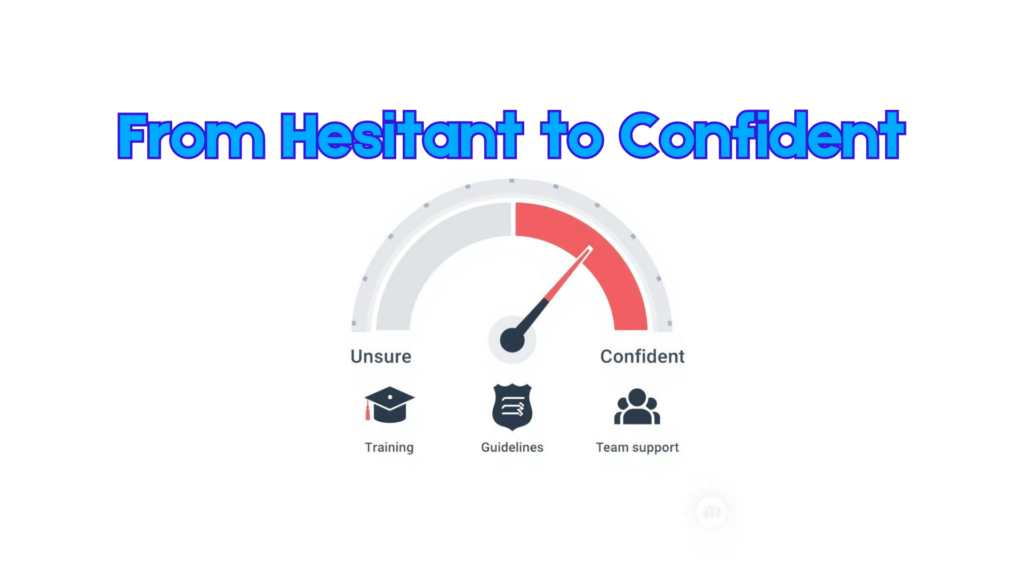
If you asked your team how they feel about using AI at work, what would you hear?
Excitement?
Uncertainty?
A cautious “maybe… but I don’t want to get in trouble”?
That mix is more common than you might think.
A recent study shows AI is now part of everyday work for most employees. Roughly four out of five workers use some form of AI in their role, and more than half regularly use AI assistants to save time. But widespread use doesn’t automatically translate to comfort.
In fact, many people are using AI quietly.
Why? Because the worry isn’t always about the tool—it’s about perception.
Some employees fear they’ll look lazy if they rely on AI. Others worry colleagues will doubt their skills, question their judgment, or assume they’re cutting corners. It’s a strange dynamic: people may trust AI to help them work faster, but they don’t always trust how others will react to them using it.
Here’s the reality: AI is supposed to support people, not replace them. Used well, it’s a productivity partner—handling drafts, summaries, and first passes so your team can focus on higher-value work like strategy, creativity, and problem-solving.
But that only works when people feel confident.
And this is where many organizations—especially small and midsized ones—get stuck. Only about one in three workers has received any formal AI training. Most are learning through trial and error, which is a recipe for inconsistent results, avoidable mistakes, and growing mistrust.
Confidence also isn’t evenly distributed. Managers are far more likely to feel comfortable (around 70%). Among junior staff, confidence drops dramatically—closer to one in three.
So how do you fix it?
It starts with culture.
Leaders need to make it clear that responsible AI use is encouraged, not punished. Using AI isn’t “cheating.” It’s modern work—like using spellcheck, templates, or search. The key is using it well, safely, and transparently.
Practical ways to build AI confidence:
- Set clear expectations: When is AI appropriate? When is it not? What needs human review every time?
- Offer real training: Even short sessions on prompting, verification, and data handling build trust fast.
- Run internal “show-and-tell” sharing: Let employees demonstrate how they’re using AI to save time and reduce busywork.
- Normalize learning: Celebrate experimentation and learning loops—without shaming people for not being experts on day one.
AI confidence doesn’t appear overnight. But when people feel supported—and know the rules of the road—they’re far more likely to embrace it. That’s when you start seeing the payoff: better efficiency, smarter workflows, more creativity, and a team that’s prepared for what’s next.
 Web & Mobile Apps